
The Thermal Paradigm Shift: Navigating the Intersection of AI Physics and Digital Infrastructure

Article originally published on LinkedIn
View original article on LinkedInThe current expansion of artificial intelligence is introducing a fundamental shift in data center development, transitioning the sector from a focus on digital software to a complex challenge of physical engineering. While the previous decade was defined by Generative AI and cloud growth, the industry is now entering the era of Physical AI and high-density compute. This evolution is effectively breaking traditional data center physics, making thermal management the primary competitive differentiator for the next generation of infrastructure.
The Density Challenge and the Air-Cooling Threshold
A decade ago, the average data center rack drew between 5 and 8 kW, a load easily managed by standard computer room air conditioning (CRAC) units and raised-floor architectures. However, modern AI clusters have introduced a twenty-fold increase in thermal requirements. Standard 100+ kW racks are becoming the benchmark, and specialized platforms are already targeting 500 kW per pod.
This massive jump in density creates a significant physical bottleneck. To cool a 100 kW rack using traditional air methods, an operator would require approximately 15,700 cubic feet per minute of airflow: essentially hurricane-force winds moving through a server intake only a few inches wide. While lateral rack positioning (flipping racks into a horizontal orientation) has been proposed to push air cooling to reject up to 190 kWh of heat using 13,500 cfm, the industry is identifying a threshold where air becomes an inefficient medium for heat transfer compared to liquid.
The Migration Toward Liquid and Physics-Based Cooling
The industry is currently adopting two primary liquid cooling architectures to meet these new density requirements: Direct-to-Chip (Cold Plate), which is favored for its modularity and retrofit potential up to 100 kW; and Immersion Cooling, capable of handling extreme densities exceeding 200 kW per rack.
However, emerging innovations suggest that the future of cooling may not be limited to standard liquid loops. New physics-based modules utilizing molecular beam technology are entering the field, promising to deliver 35% more effective cooling using only ambient air. This patented approach identifies unexploited physical phenomena to eliminate the need for chillers, water, or complex plumbing, potentially reducing data center construction costs by 40% and onsite water usage by 100%. Such breakthroughs are critical as operators look to reduce the 40% of total data center power currently dedicated solely to removing heat rather than processing data.
The Impact of Photonics and Hardware Cycles
The thermal profile of the data center is also being reshaped by the transition toward silicon photonics. As optical links begin to replace copper cabling within the facility, the bandwidth bottleneck is broken, but the heat profile changes. Silicon photonics enables higher bandwidth and lower power consumption, allowing for the full interconnection of thousands of GPUs at speeds that were previously physically impossible due to signal degradation in copper.
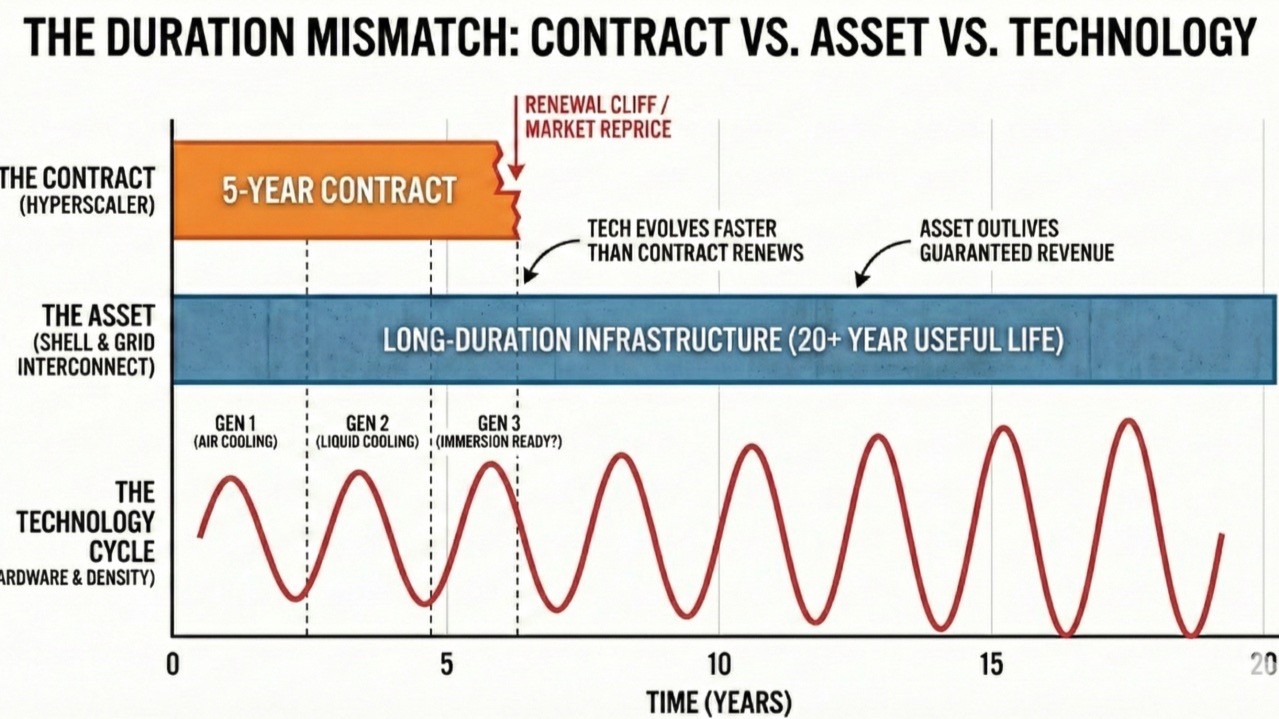
This rapid pace of technical innovation creates a temporal mismatch for investors. While a 1-GW data center campus is long-cycle infrastructure designed for a 30-year horizon, the revenue stream is now tied to hardware cycles that render themselves obsolete every 36 months. A facility designed for today's Blackwell chips might hit a thermal wall or a power architecture wall when the next generation of chips (such as the Vera Rubin platform) arrives. Consequently, an AI data center is no longer just real estate; it is a housing for rapidly depreciating industrial machinery.
The Inverted Asset Class and the "Year-X Survival Model"
Investors and boards are increasingly advised to move beyond traditional perpetuity thinking. The belief that a 20-year lease with a creditworthy hyperscaler guarantees a bond-like return is being questioned. If a facility falls short on thermal capacity or fabric topology by Year 6, the tenant may view an exit as more viable than a negotiation.
To mitigate this, specialized investors are adopting a "Year-X Survival Model" for underwriting. This approach hard-codes the cost of technical relevance, explicitly carrying retrofit CAPEX (estimated at 150–200 per kW) to maintain fitness for future hardware refreshes. Boards are now asking a simple strategic question: What is this asset worth the day the contract expires if a renewal does not happen? If the answer relies on a spreadsheet assumption rather than a technical resale thesis, the site may fall into the "encumbered power trap," where the cost to renovate the facility for next-gen density exceeds the value of the grid connection itself.
The BtMData Approach: Strengthening the Grid Instead of Waiting
While cooling is a technical hurdle, it remains secondary to power access. A high-efficiency liquid cooling system is only valuable if the utility can deliver the necessary electrical capacity. Across Europe and the US, interconnection queues currently last between 3 and 7 years, far longer than the construction of the facility itself.
The philosophy of BtMData provides a technical "fast pass" to resolve this. By implementing Conditional Firm Service combined with Bring-Your-Own-Capacity (BYOC), data centers can connect to the grid 3 to 5 years faster than through traditional processes. Under this model, the facility relies on grid power for more than 99% of the year but agrees to use on-site resources (like BESS or modular gas generation) during rare periods of grid stress.
This technical proposal allows operators to connect now and operate flexibly, gaining early access to compute capacity that can generate between $0.9 billion and $4.3 billion in additional EBITDA per site. By treating the data center as a grid-stabilizing asset rather than a burden, operators can bypass the gridlock and ensure their infrastructure remains sovereign and resilient.
The 12-Month Outlook
In the coming year, those who have integrated future-proofed thermal designs with agile power access will find themselves in a position of significant advantage. Things you will look with envy in 12 months include having an operational AI factory generating revenue while competitors remain stuck in permitting queues or stuck behind thermal walls.
The transition to high-density cooling and photonic interconnects is not just an upgrade; it is a reinvention of the asset class. As we move toward 2030, the winners will be those who recognize that the AI race is a megawatt duel — a duel won by those who can manage heat at the speed of light and connect to power at the speed of software.
---
Key Insights for Boards
- Durable Business Models: Infrastructure must be adjusted for technology ebbs and flows, allowing for the scaling of investments as supply patterns shift.
- Modular Reality Checks: Standardized design elements and modular builds are necessary to compress time spent on site in a market with a limited contractor pool.
- The Human Element: The blue-collar boom predicted by Jensen Huang means that skilled tradespeople (electricians and plumbers) are now the frontline of the digital economy.
The era of the generalist data center investor is ending; the era of the specialized, technically-driven digital defense strategist has begun.
Related Articles
The Trillion-Dollar Illusion: Why Data Centers Aren't the Next Renewables
The AI revolution has inverted the asset class. We are no longer building real estate; we are building rapidly depreciating industrial machinery inside a concrete box.

10 Things Your Competitors Will Look at with Envy in 12 Months: 2026 Data Center Trends
The global race for AI has entered its most physical phase. As we move into 2026, the industry is shifting from software algorithms to a brutal competition for power, land, labor, and raw materials.
Are We Building the Next Bubble in Data Infrastructure?
AI capex is reshaping economies, but is construction running ahead of sustainable revenue? An analysis of the $800B gap between infrastructure investment and revenue generation.