
Walking MWC With a Data Center Mindset

Article originally published on LinkedIn
View original article on LinkedInToday marks the first day of the 2026 Mobile World Congress, which has been held for the last 20 years in my hometown Barcelona.
MWC has become a live preview of compute demand for the next five years. Every AI assistant demo, every enterprise automation pitch, every edge computing showcase implies something physical somewhere: power, cooling, substations, grid capacity.
I've checked exhibitors and I've prepared this guide to help you find the exhibitors that are most relevant to the data center business.
Stop 1 – Hall 3: NVIDIA
*AI roadmap = infrastructure roadmap*
Start in Hall 3, where NVIDIA typically anchors the AI conversation. You're not here to look at GPUs. You're here to recalibrate your facility assumptions.
Ask yourself:
- What rack-level power envelope are they implicitly designing for?
- How does this change cooling architecture?
- What does this mean for 2026–2028 deployments?
When NVIDIA moves from 1,200W per chip to 2,500W+ class accelerators, this creates massive mechanical, electrical and plumbing implications for your data center.
Spend 20 minutes here and you'll understand whether your next project should be engineered for 40 kW racks or 120 kW racks.
Stop 2 – Hall 2: Schneider Electric
Now walk to Schneider Electric in Hall 2, the energy management zone. This is where ambition meets physics.
Look at:
- Modular power blocks
- Prefabricated data center modules
- Liquid cooling distribution systems
- Microgrid integration platforms
Ask directly: "If I need to deploy 60 MW in 24 months, what is the realistic path?"
Schneider's presence at MWC is not just about automation. It reflects the merging of energy management and digital infrastructure. The companies that understand this convergence will scale faster.
Stop 3 – Hall 2: Vertiv
Stay in Hall 2 and visit Vertiv. This is the thermal and infrastructure area.
Focus on:
- Direct-to-chip cooling
- Rear-door heat exchangers
- Hybrid air-liquid systems
- Lead times
The important question is not whether liquid cooling works. It does. The question is: How do I deploy it incrementally without overbuilding?
Most real-world projects today are hybrid. High-density AI pods with liquid cooling. Legacy halls remaining air-cooled. Flexibility is the keyword.
Stop 4 – Hall 4: Telecom Operators
*(Telefónica, Deutsche Telekom, Orange, Vodafone)*
Now shift perspective. Go to Hall 4, where major operators anchor their stands. On the surface, they are talking about 5G, private networks, IoT. Underneath, edge compute is the subtext.
Ask:
- Are you hosting inference locally?
- Are you developing regional compute hubs?
- Are you partnering with colo operators?
- Where are your substations?
Telcos are repositioning. Some will become serious distributed compute players. Others will remain marketing-heavy. You can tell which is which by how concretely they speak about power and facilities.
Stop 5 – AWS, Microsoft, Google Cloud
*Cloud presence across multiple halls*
Their stands are large. The messaging is polished. Look beyond partnerships and AI copilots. Focus on:
- Regional expansion signals
- Edge strategy
- Sovereign cloud narratives
- Energy sourcing claims
Every "AI for enterprise" demo implies megawatts somewhere. The key question: Are they building, leasing, or both? And where? Their appetite determines colo absorption across Europe.
Stop 6 – 4YFN (Hall 8)
*Startup signal = future demand*
Now cross to Hall 8 for 4YFN. It looks like a startup fair. In reality, it's a megawatt forecast. Every AI startup demo represents backend compute demand. When you see 200 AI-native startups in one hall, you're looking at latent infrastructure growth. If even 10% scale meaningfully, that translates into real absorption. This is where demand begins before it shows up in leasing data.
Stop 7 – Energy & Microgrid Players
*Scattered across energy zones*
Look for:
- Battery storage providers
- On-site generation firms
- Microgrid integrators
- Grid optimization platforms
Power is now the gating factor in Europe.
Ask:
- Can you compress interconnection timelines?
- How are you structuring behind-the-meter capacity?
- What does regulatory approval look like?
What You Should Leave MWC Knowing
If you walk it correctly, you should leave with clarity on:
- The density you must design for.
- The cooling architecture that is bankable.
- The grid timelines that are realistic.
- The distributed model that may unlock new regions.
Related Articles

10 Things Your Competitors Will Look at with Envy in 12 Months: 2026 Data Center Trends
The global race for AI has entered its most physical phase. As we move into 2026, the industry is shifting from software algorithms to a brutal competition for power, land, labor, and raw materials.
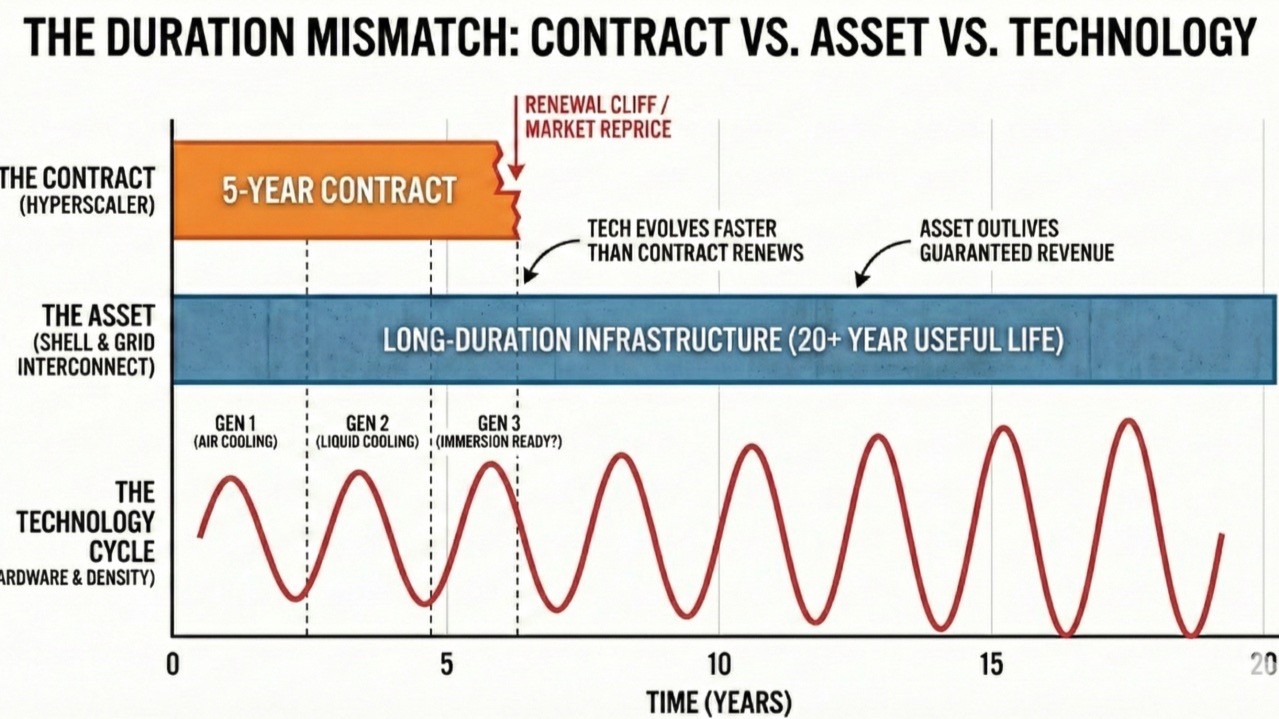
The Trillion-Dollar Illusion: Why Data Centers Aren't the Next Renewables
The AI revolution has inverted the asset class. We are no longer building real estate; we are building rapidly depreciating industrial machinery inside a concrete box.

What Is Sovereign AI Infrastructure? A Technical Guide to Requirements, Energy and the AI Factory Model
Sovereign AI infrastructure is the full stack — compute, power, data, jurisdiction — a country or enterprise needs to train and run AI without depending on a foreign hyperscaler. This guide breaks down the technical requirements, energy constraints, and the AI Factory model that defines it in 2026.